
SDT MEANING
In data security, SDT stands for Secure Digital Transport: a category for moving sensitive data in and out of any system without logins, portals, apps, or residue. (SDT is also used elsewhere for Self-Determination Theory in psychology and as a texting abbreviation. This page covers the data-transport meaning.)
Every architecture decision about moving sensitive data has historically forced a choice between two failure modes. The most volatile system in the world would be one where everyone and anyone could gain access. Easy to use, but unsafe.
The most secure solution on the planet would be one where no one could ever log in. Safe, but unusable. Every existing secure-data product picks a point on that spectrum and lives with the cost. Portals trade convenience for security. Encrypted email trades security for convenience. Managed File Transfer trades both for infrastructure overhead.
What if there was a way for a system to transport documents and data in and out without anyone ever having to log in? Most secure AND easiest to use. That makes no sense within the volatile-vs-secure paradigm, until someone understands Secure Digital Transport. SDT is what the paradigm becomes once the paradox is dissolved.
Secure Digital Transport is a segregated service to digitally transport and intelligently track data, enabling actionable logistics via a stateless environment where the connection between endpoints is dynamic and transactions are disposable. No external access is required to the endpoint delivery locations, endpoint storage locations are agnostic, leaving zero residual imprints.
SDT is allowing companies to transport data and documents in and out of their systems without anybody ever having to log into those systems, all being accomplished encrypted from pickup to delivery and without pins, passwords, logins, accounts, apps, or software to download on either side of the transmission. Furthermore, upon delivery the encrypted container and all the data within it evaporates, leaving no recoverable residue.
Secure Digital Transport is not just a technology. It is a business strategy for defining how sensitive data is transported.
For the practical version, see the guide: how to send sensitive documents without a portal, a login, or an email attachment.
PILLAR ONE
Point Delivery System
PILLAR TWO
Endpoint Storage Agnostic
PILLAR THREE
Zero Residual Footprint
PILLAR ONE
A segregated service to digitally transport data encrypted from pickup to delivery via a stateless environment where the connection between endpoints is dynamic and transactions are disposable.
Most of what gets called "file sharing" is not actually sharing. True sharing in a technological sense requires two or more parties on the same system at the exact same time. Over 95% of the time when that sharing requirement was in place, nothing actually needed to be shared, only picked up or dropped off. SDT removes the false-sharing requirement and replaces it with sending.
That distinction matters because the whole stack of login-based secure-file products exists to solve a problem that was never the real problem. The recipient does not want to be in your system. They want the document. The friction is the failure mode.
The architectural payoff is one-to-many access through SDT, versus traditional many-to-one access through gateways and portals. The sender publishes once. Every recipient picks up or drops off through the same stateless pipe. No new account, no provisioned identity, no portal session to keep alive.

PILLAR TWO
The transportation system does not impose temporary or permanent storage limitations, and enables automated, intelligent routing of data, using tracking metadata, directly to the optimal location or System of Record (SOR).
Managed File Transfer emerged in the 2000s to address FTP and SMTP deficiencies. The cost was heavy on-premises infrastructure, dedicated integrators, ongoing IT overhead, and a central storage layer that became a High Value Target for hackers. The data piled up in the middle because the architecture required it to.
SDT does not have a middle. There is no master controller of encryption keys, passwords, or routing information. The intelligence is embedded into each transaction as tracking metadata, available indefinitely via API for audit. The transport carries its own context, so the routing decision can happen at the edge instead of in a central queue.
The intelligent routing payoff is that data moves from the consumer directly to the optimal System of Record based on Technology, Operations, or Security requirements. The same transaction can land in a HIPAA-scoped repository, a GDPR-scoped repository, or a PCI-scoped repository depending on the metadata, without an integrator re-routing it in the middle.

PILLAR THREE
Items are temporarily stored during transport and then securely removed once delivery is confirmed. A single chain of custody between pickup and delivery points where duplicate copies are not created as part of the process.
Every current means of digital transportation, fax, FTP, secure email, portals, inherently multiplies the data. Most of them leave at least five residual copies behind, typically unsecured, scattered across mail servers, file shares, employee desktops, archive systems, and the recipient's own environment. Those copies are poisonous breadcrumbs. They are what data thieves follow.
Imagine what would happen if an armored service provider like Brinks made multiple stops and left valuable goods along the way. They would not have been in business since 1859. The expectation in physical custody is single chain of custody, pickup to delivery, no copies left behind. SDT applies the same expectation to digital custody.

PILLAR THREE, CONTINUED
The compliance scope payoff follows directly from the architecture. SDT transports rather than stores, so companies significantly reduce compliance scope across every major framework. PCI, HIPAA, GDPR, and FERPA exposure shrinks because regulated data is not in the environment. You cannot lose what you do not keep.
The auditor's walkthrough becomes a different conversation. Instead of inventorying who has access to which copy across mail servers, file shares, and archive systems, the institution presents a single per-document audit trail with deterministic deletion. SOC 2, HIPAA, GLBA, and GDPR documentation all simplify because the data does not persist in scope.
"The Healthcare industry has a multifaceted problem with mail, in both electronic and printed form. The industry is not immune to the same illnesses we see in other verticals such as the very common scenario of phishing emails sent to dupe users into clicking and entering their email credentials on a phony site. The freshly stolen login information is then used to access the user's cloud-based mail account, and any patient data that is chilling in the Inbox, or Sent Items, or other folder for that matter is considered compromised, and its disclosure time."
FOR THE CIO AND CTO CHAIRS
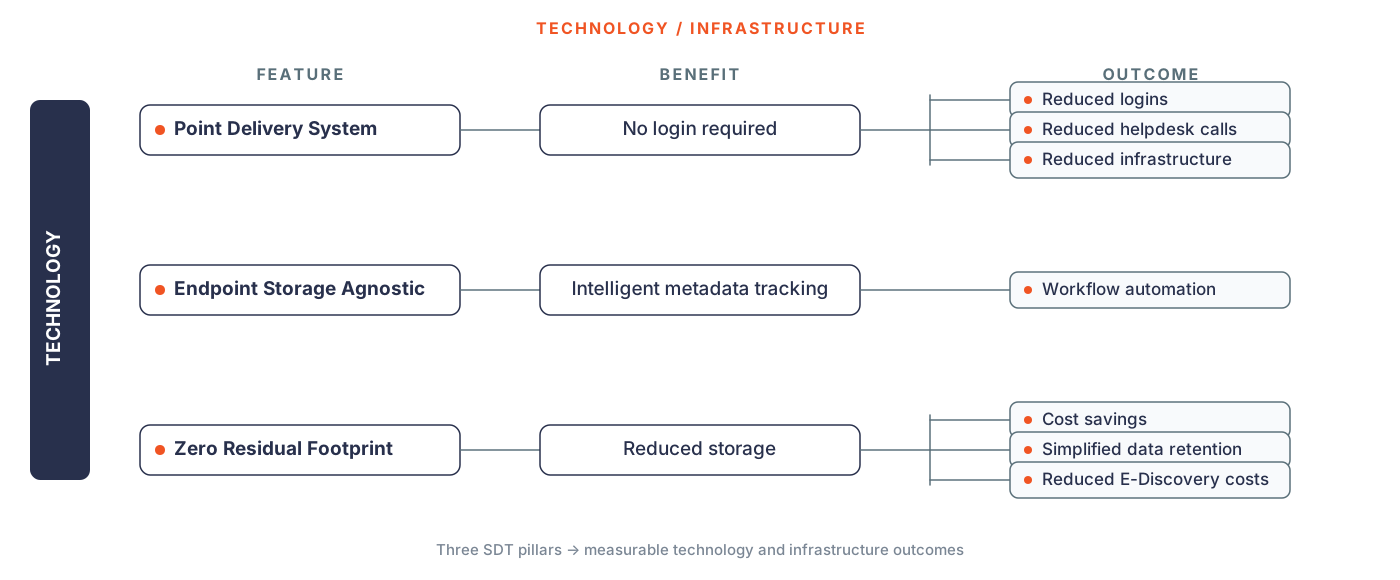
The primary benefit of SDT for the technology leader is architectural simplification across infrastructure, identity, and data-retention layers. Because consumers and counterparties are not logging into systems, logins are significantly reduced. HelpDesk calls and account-recovery tickets drop with the logins, reducing overall IT operational costs and the supporting identity infrastructure (SSO, MFA, password reset workflows, account provisioning) at the same time. In addition, because sensitive data is only stored in the official System of Record and not duplicated onto employee desktops, random file shares, mailbox archives, or shadow-IT cloud storage, overall data retention is simplified and E-Discovery costs can be significantly reduced over the lifetime of the system. The technology leader is no longer paying to maintain a sprawl of secondary data stores that exist only because the legacy transport architecture required them.
FOR THE COO AND CFO CHAIRS
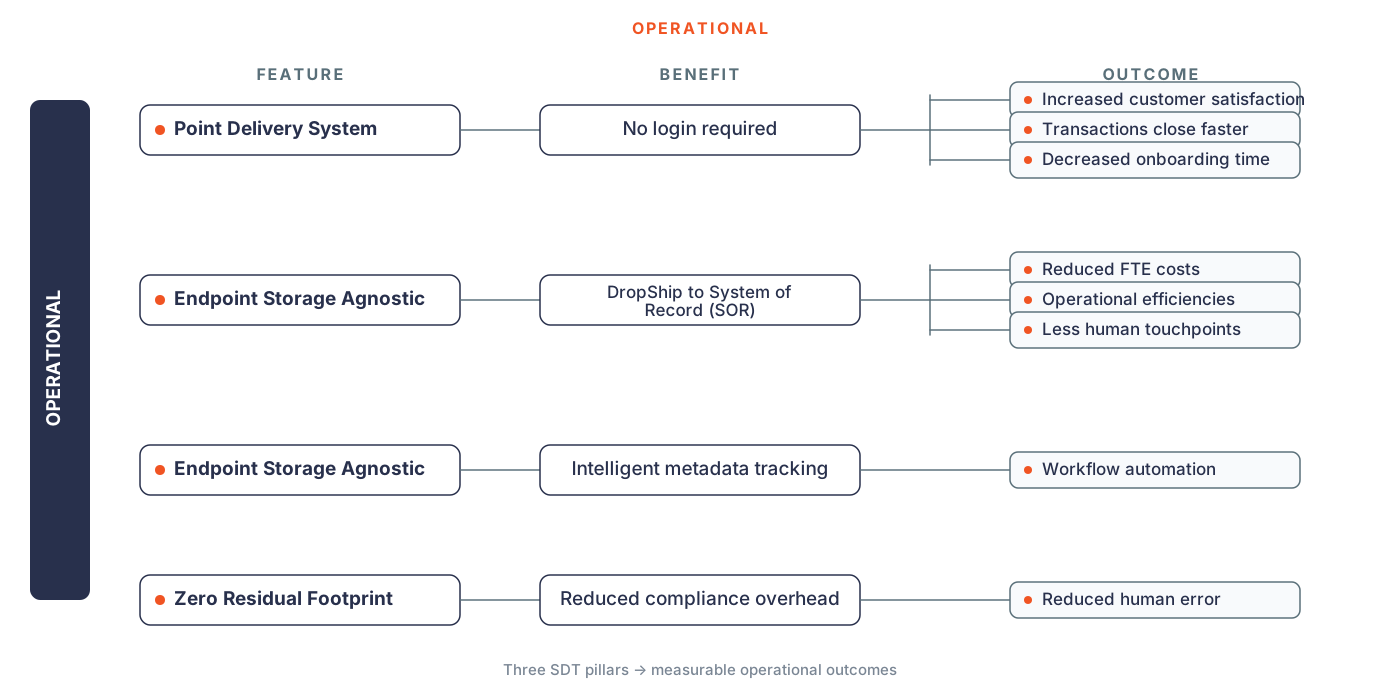
SDT provides direct return on investment through measurable cost savings and operational efficiency gains that the operations and finance chairs can quantify quarter over quarter against existing benchmarks. By leveraging tracking metadata intelligence built into every transaction, the business is able to implement workflow automation to reduce manual human efforts and the errors that come with them. This results in decreased onboarding times for new customers, transactions closing faster, lower error-rate-driven rework, fewer customer-facing support escalations, and overall increased customer satisfaction and retention. The COO and CFO chairs see the operational efficiency in throughput metrics and the financial impact in reduced cost-per-transaction, faster receivables conversion, and lower cost-to-serve in the same monthly or quarterly reporting cycle that the rest of the business already runs on, without standing up a new measurement program to capture the gain.
FOR THE CISO CHAIR
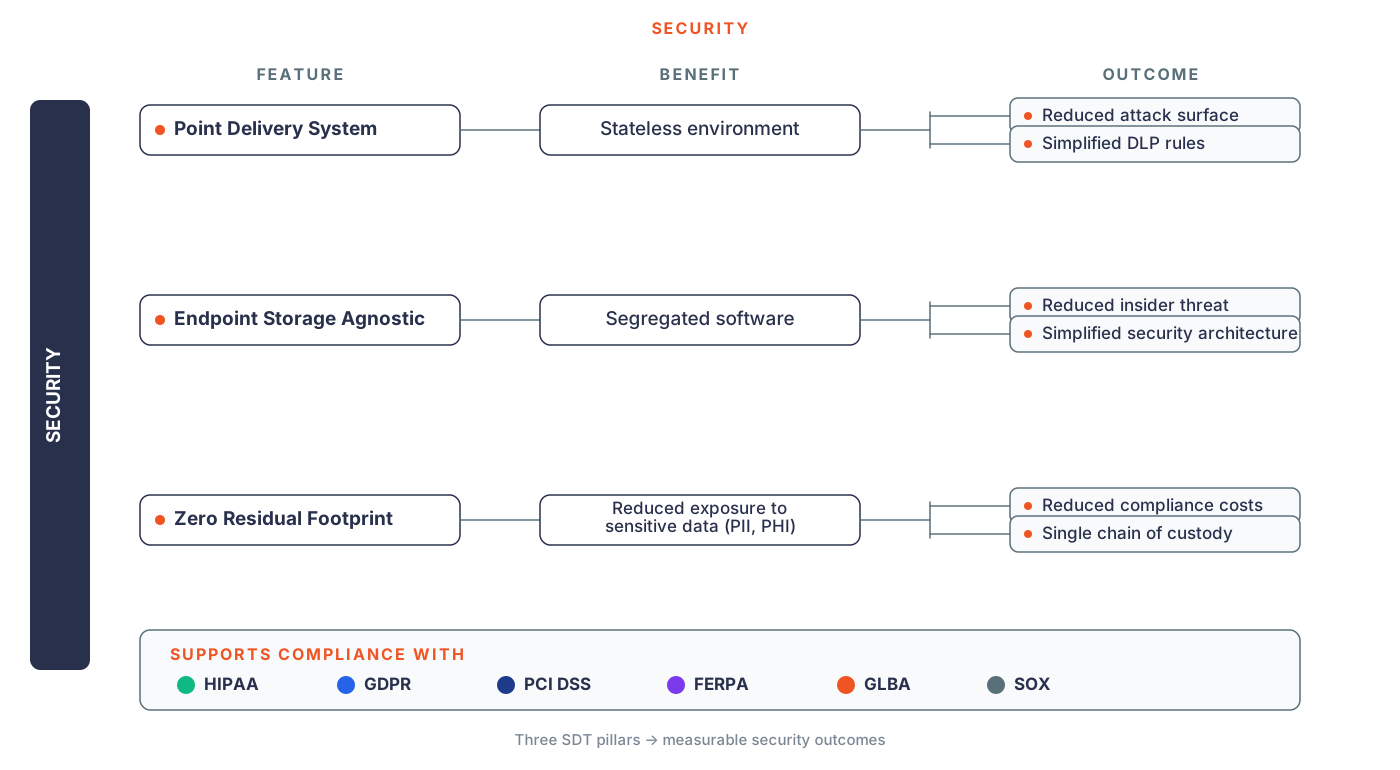
SDT is a Swiss army knife which can be used multiple times throughout the business to improve the overall security posture and enable business transformation across regulated workflows. Since SDT is a stateless and segregated environment, the company's overall attack surface is reduced, thereby simplifying the security architecture and reducing overall risks at the architectural level rather than at the control level where most CISOs are forced to operate. By reducing exposure to sensitive data, insider threats are also reduced and more easily detected by simplified Data Loss Prevention (DLP) rules that no longer have to police every file share, mailbox, and shadow-IT cloud bucket. Since SDT minimizes manual human touch-points and provides a single chain of custody per document, compliance attestation across SOC 2, HIPAA, GLBA, GDPR, PCI DSS, and FERPA frameworks is also simplified.
WHERE THIS IS GOING
Every major system roadmap will include Secure Digital Transport in the next 5 years as a build concept and overall business strategy. A market-shift is already underway across regulated industries, and Botdoc is pioneering what SDT is today and what it means in the future. The legacy stack of digital transport protocols was designed for problems that no longer match how regulated industries operate in 2026.
SDT is what comes next.
Three tracks lead from this page to a working SDT deployment. The track you pick depends on whether you want to see what is already running, build directly on the underlying engine, or scope something custom on top of the platform with our team. Each track resolves into a concrete next step in minutes. The "See what is built on it" track walks you through the live External Application Projects (SecureMFP for MFP scan security, the SecureMyDealer auto family, Spark for SMB self-serve) and Third-Party Integrations (Edward Jones SDX, Cloud Maven Secure File Transport for Salesforce, VedaPointe.Send for EPIC) so you can map your use case to a pattern that already works. The "Build on the SDT Engine" track is the developer entry point. The custom scoping track is the conversation with Karl and the technical team.